
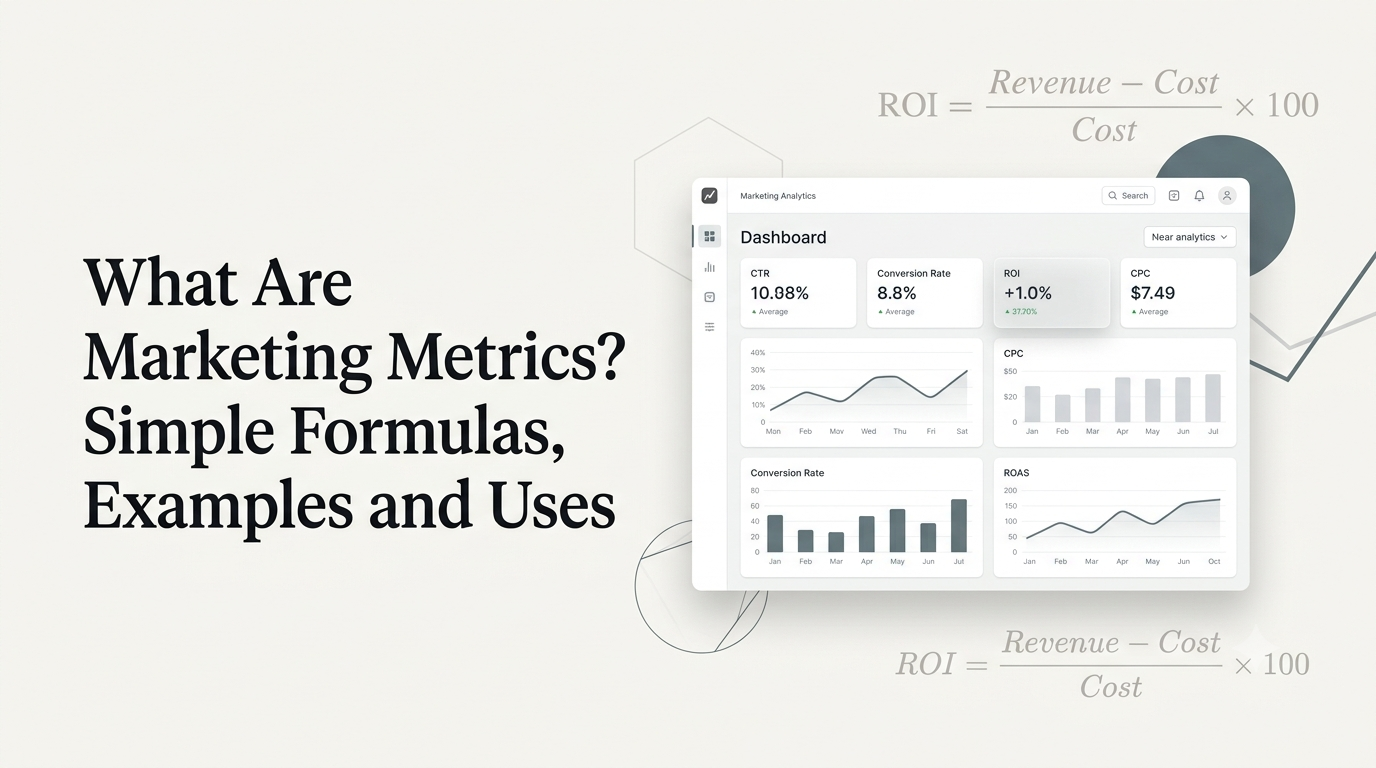
What Are Metrics in Marketing?
Marketing metrics are measurable data that help companies evaluate the effectiveness of their marketing campaigns.
Explore Marketing Metrics →
Measure.
Analyse.
Improve.
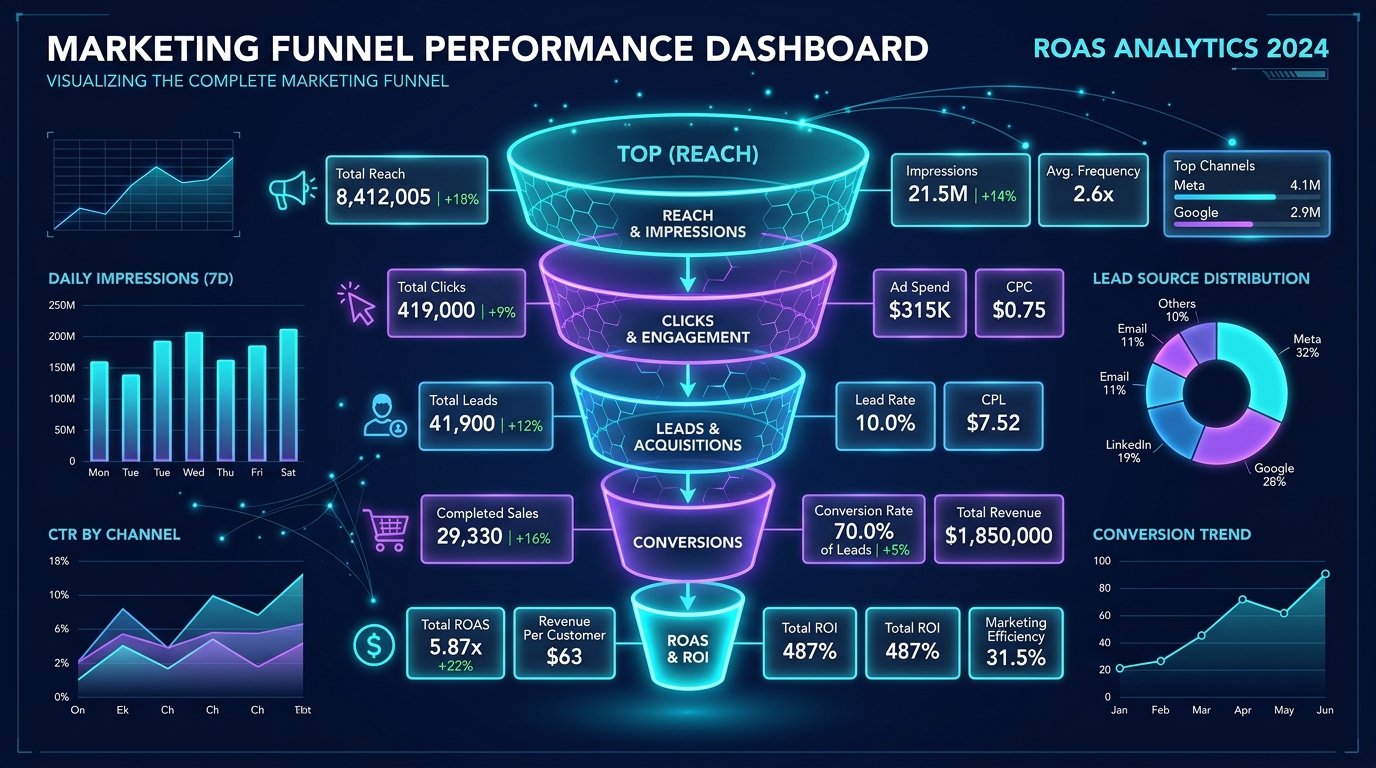
Reach, impressions, clicks, click-through rate (CTR), conversion rate, cost per click (CPC), cost per lead (CPL), customer acquisition cost (CAC), and return on investment (ROI) are examples of common marketing metrics.
What Are Metrics in Marketing?
Marketing metrics are measurable data that help companies evaluate the effectiveness of their marketing campaigns.
Marketing metrics are measurable data that help companies evaluate the effectiveness of their marketing campaigns. Campaigns, ads, social media, SEO, email marketing, and other marketing activities are tracked using them.
Reach, impressions, clicks, click-through rate (CTR), conversion rate, cost per click (CPC), cost per lead (CPL), customer acquisition cost (CAC), and return on investment (ROI) are examples of common marketing metrics. To explain it simply, marketing metrics are data that assist marketers in determining success and improving their marketing strategies.
For example, a bakery in Delhi may run an Instagram ad for customised birthday cakes. The bakery should not only check how many people liked the ad. It will also wanna know how many people clicked, called, messaged, or ordered a cake.
Marketing Metrics
Explore the important marketing metrics explained below.
Reach
Reach means the number of different people who saw your ad, post, reel, or content.
- New business launches
- Festival offers
- Local brand awareness campaigns
Impressions
Impressions show how many times your ad or post was displayed on a screen.
- Brand awareness campaigns
- Remarketing ads
- Checking ad frequency
Click-Through Rate (CTR)
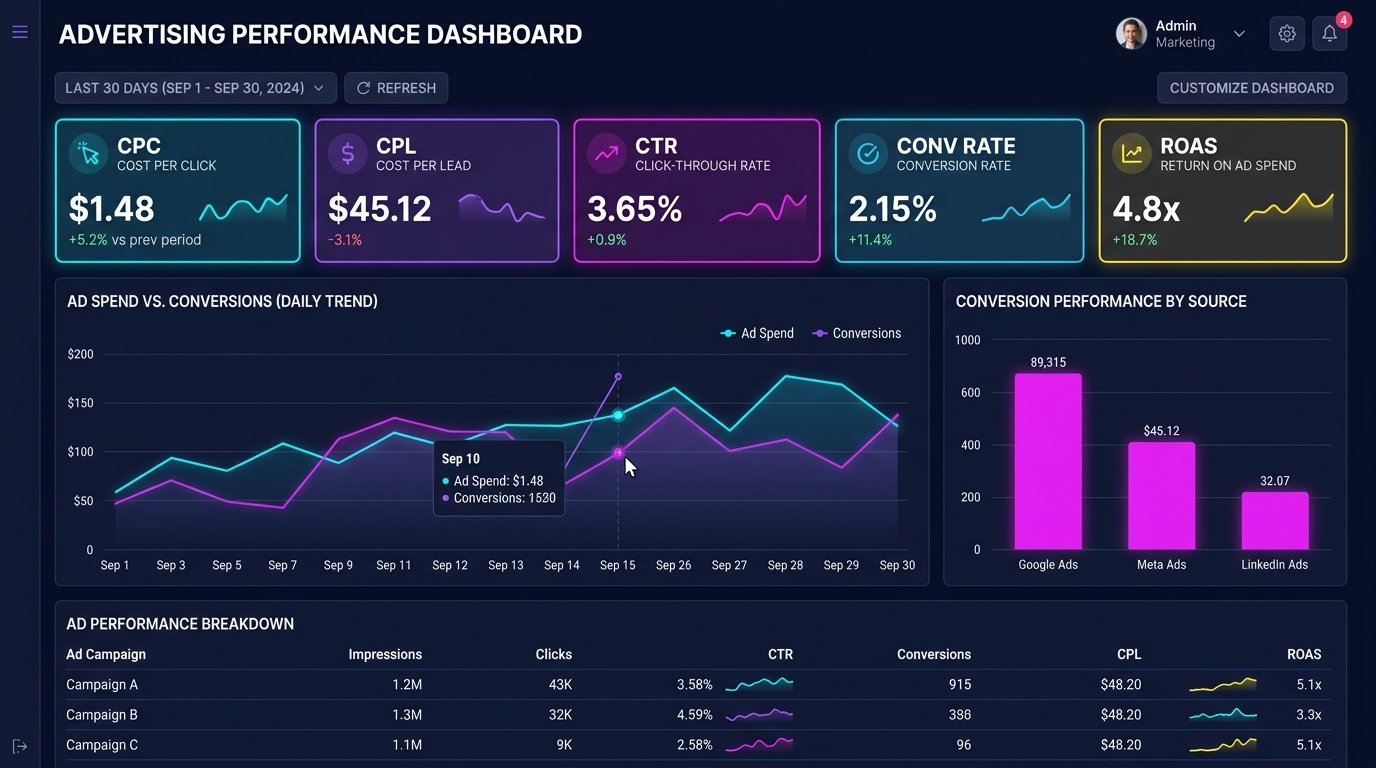
CTR shows the percentage of people who clicked on your ad after seeing it.
- Google Search Ads
- Instagram and Facebook Ads
- Email campaigns
Cost Per Click (CPC)
CPC tells you how much money you pay for one click on your advertisement.
- Google Search Ads
- Website traffic campaigns
- Landing page testing
Leads
A lead is a person who shows interest in your business by taking an action.
- Contact form submission
- Phone call
- WhatsApp message
Conversion Rate
Conversion rate tells you how many visitors completed your desired action.
- Lead generation campaigns
- E-commerce websites
- Landing pages
Cost Per Lead (CPL)
CPL shows how much money you spend to get one lead or enquiry.
- Property leads
- Education leads
- B2B services
Return on Ad Spend (ROAS)
ROAS shows how much revenue you earned for every rupee spent on advertising.
- E-commerce brands
- Fashion brands
- Online gifting businesses
Organic Traffic
Organic traffic means visitors who come to your website through unpaid Google search results.
- SEO
- Content writing
- Local product and service searches
Engagement Rate
Engagement rate shows how many people interact with your website or social media content.
- Instagram reels
- Facebook posts
- LinkedIn content
Bounce Rate
Bounce rate shows the percentage of visitors who leave your website without meaningful engagement.
- Slow website speed
- Weak page content
- Poor mobile experience
1. Reach
Simple Meaning
Reach means the number of different people who saw your ad, post, reel, or content.
If one person sees your Instagram ad five times, that person is counted once in reach, but if 5 different people see your Instagram ad, it will be counted as 5 reach.
Formula
Practical Example
💡 Practical Scenario
A bakery runs a Facebook ad for Raksha Bandhan cake hampers.
- 10,000 different people see the ad.
- Reach = 10,000
When It Matters
Reach matters when your goal is to make more people aware of your business, offer, or brand.
It is useful for:
- New business launches
- Festival offers
- New product announcements
- Local brand awareness campaigns
- Social media marketing campaigns
A digital marketing agency may use reach to check whether an ad is reaching enough people in Delhi or nearby target locations.
2. Impressions
Simple Meaning
Impressions show how many times your ad or post was displayed on a screen. One person can create more than one impression if they see the same ad multiple times.
Formula
Practical Example
💡 Practical Scenario
Your cake ad reaches 10,000 people, but some people see it more than once.
- Reach = 10,000 people
- Impressions = 18,000 times
This means people saw the ad 18,000 times in total.
When It Matters
Impressions matter when you want to understand how often people are seeing your ad.
They are useful for:
- Brand awareness campaigns
- Remarketing ads
- New product promotions
- Checking ad frequency
Very high impressions with low clicks may mean that people are seeing the ad but are not interested in it.
3. Click-Through Rate (CTR)
Simple Meaning
CTR shows the percentage of people who clicked on your ad after seeing it.
A higher CTR can mean that your ad image, headline, offer, or message is attracting the right audience. Google defines CTR as clicks divided by impressions.
Formula
Practical Example
💡 Practical Scenario
Your Google Ad receives:
- Impressions = 5,000
- Clicks = 150
Your CTR is 3%.
When It Matters
CTR matters when you are running:
- Google Search Ads
- Instagram and Facebook Ads
- Display Ads
- Email campaigns
- SEO title and meta description testing
If your CTR is low, you may need to improve the ad copy, offer, keyword targeting, or creative. A top marketing agency should check CTR along with conversions, not treat it as the only success metric.
4. Cost Per Click (CPC)
Simple Meaning
CPC tells you how much money you pay for one click on your advertisement.
Google Ads calculates average CPC by dividing the total click cost by total clicks.
Formula
Practical Example
💡 Practical Scenario
You spend ₹3,000 on a Google Ads campaign and get 200 clicks.
Your average CPC is ₹15.
When It Matters
CPC matters when your campaign goal is website visits or traffic.
It is useful for:
- Google Search Ads
- Website traffic campaigns
- Product page campaigns
- Landing page testing
- Competitor keyword campaigns
A low CPC is not always good. If you get cheap clicks but no genuine enquiries or sales, the traffic may not be useful.
5. Leads
Simple Meaning
A lead is a person who shows interest in your business by taking an action.
A lead can come through:
- Contact form submission
- Phone call
- WhatsApp message
- Demo booking
- Quote request
- sign-up
- Product enquiry
Formula
Practical Example
💡 Practical Scenario
A web design company runs ads for web development in Delhi.
In one month, it receives:
- 35 contact-form submissions
- 20 WhatsApp enquiries
- 15 phone-call enquiries
When It Matters
Leads matter most for service-based businesses, such as:
- Clinics
- Real estate companies
- Coaching institutes
- Law firms
- Web development companies
- SEO agencies
- Local service businesses
A business searching for web development near me may become a lead after filling out a website enquiry form.
6. Conversion Rate
Simple Meaning
Conversion rate tells you how many visitors completed your desired action.
A conversion can be a sale, lead, form fill, call, WhatsApp click, booking, or app download. It is different for every niche.
Formula
Practical Example
💡 Practical Scenario
A bakery website gets 500 visitors from an ad campaign.
- Website visitors = 500
- Cake orders = 25
The website conversion rate is 5%.
When It Matters
Conversion rate matters when you want to know whether your website or landing page is turning visitors into customers.
It is useful for:
- Lead generation campaigns
- E-commerce websites
- Product pages
- Landing pages
- Booking pages
- Google Ads and Meta Ads campaigns
If clicks are high but conversion rate is low, the issue may be with the website page, pricing, product details, page speed, contact form, or offer.
7. Cost Per Lead (CPL)
Simple Meaning
CPL shows how much money you spend to get one lead or enquiry.
It helps you understand whether your lead generation campaign is affordable.
Formula
Practical Example
💡 Practical Scenario
You spend ₹12,000 on Facebook and Instagram lead ads.
- Ad spend = ₹12,000
- Leads received = 60
Your cost per lead is ₹200.
When It Matters
CPL matters when your main goal is enquiries, calls, or form submissions.
It is useful for:
- Property leads
- Education leads
- Healthcare leads
- B2B services
- Web development leads
- SEO leads
- Local business enquiries
Google describes cost per conversion as total cost divided by conversions; when the conversion is a lead, this works as CPL.
Do not only chase a low CPL. A ₹100 lead is not useful if it is not relevant, while a ₹500 lead can be valuable if it turns into a high-value customer.
8. Return on Ad Spend (ROAS)
Simple Meaning
ROAS shows how much revenue you earned for every rupee spent on advertising.
It is one of the most useful metrics for e-commerce brands and businesses that can track sales directly from ads. Google calculates conversion value per cost by dividing total conversion value by total ad cost.
Practical Example
💡 Practical Scenario
A bakery spends ₹10,000 on Instagram ads for online cake orders.
- Ad spend = ₹10,000
- Sales from ads = ₹50,000
This means the bakery earned ₹5 for every ₹1 spent on ads.
When It Matters
ROAS matters when you are selling products directly through a website.
It is useful for:
- E-commerce brands
- Cake and bakery websites
- Fashion brands
- Beauty products
- Electronics stores
- Online gifting businesses
Remember that ROAS shows revenue, not final profit. Product cost, packaging, delivery, staff cost, and other business expenses should also be considered.
9. Organic Traffic
Simple Meaning
Organic traffic means visitors who come to your website through unpaid Google search results.
For example, someone searches “best birthday cake delivery in Delhi” on Google and clicks your website without seeing a paid ad first.
Practical Example
💡 Practical Scenario
Your website receives 4,000 visitors in one month.
- Organic Visitors from Google search = 1,600
- Total visitors = 4,000
Organic traffic contributes 40% of total website traffic.
When It Matters
Organic traffic matters when you are doing SEO and content writing.
It is useful for businesses targeting searches such as:
- best SEO agency near me
- marketing agency near me
- best marketing agency in delhi
- web development near me
- Local product and service searches
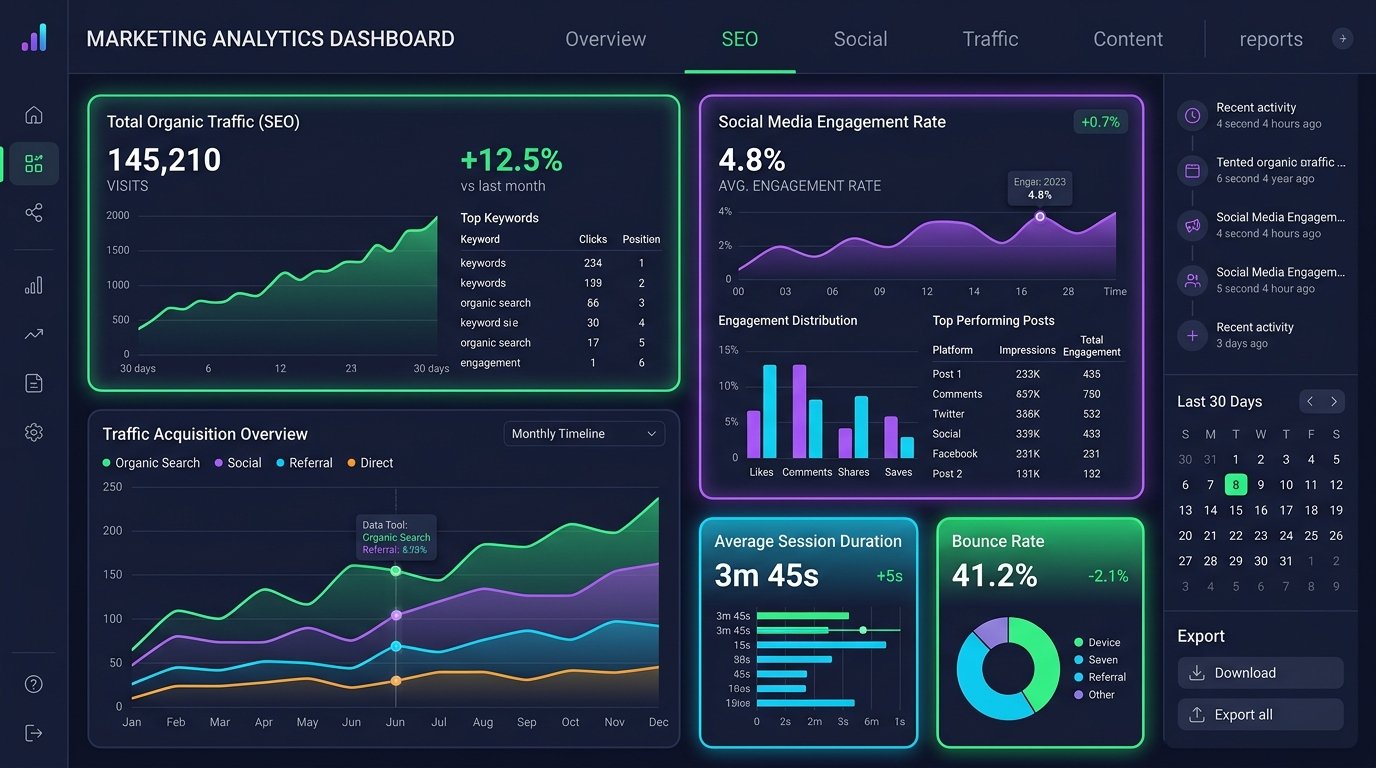
Google Search Console and Google Analytics can show organic search clicks and related search metrics of websites
10. Engagement Rate
Simple Meaning
Engagement rate shows how many people interact with your website or social media content.
For a website in Google Analytics 4, engagement rate is the percentage of engaged sessions out of total sessions.
Formula
By Reach: (Total Engagements ÷ Total Reach) × 100
By Impressions: (Total Engagements ÷ Total Impressions) × 100
Practical Example
💡 Practical Scenario
An Instagram reel receives:
- Reach = 10,000
- Likes = 350
- Comments = 50
- Shares = 75
- Saves = 125
The engagement rate is 6%.
When It Matters
Engagement rate matters when you want to understand whether people find your content useful, interesting, or worth sharing.
It is useful for:
- Instagram reels
- Facebook posts
- LinkedIn content
- Blog pages
- Educational videos
- Brand awareness campaigns
For a bakery, a cake-design reel with high saves and shares may show that people are considering it for a future order.
11. Bounce Rate
Simple Meaning
Bounce rate shows the percentage of visitors who leave your website without meaningful engagement.
In Google Analytics 4, bounce rate is the opposite of engagement rate.
Practical Example
💡 Practical Scenario
If your website engagement rate is 65%:
Your bounce rate is 35%.
When It Matters
Bounce rate matters when you want to find pages that may not be matching user expectations.
A high bounce rate may happen because of:
- Slow website speed
- Weak page content
- Wrong keyword targeting
- Poor mobile experience
- Confusing design
- No clear call-to-action
- Irrelevant ad traffic
For example, if someone searches for a best marketing agency near me, the agency should not only aim for website traffic. It should also measure contact-form submissions, calls, WhatsApp clicks, and qualified leads.
"The main purpose of marketing metrics is simple: understand what is working, improve what is weak, and use your budget in a smarter way."
Ready to Maximize Your Marketing ROI?
Partner with leading performance and digital marketing experts to measure, analyze, and scale your brand's growth with precision.
Chat on WhatsApp: +91 87440 35518 ↗