
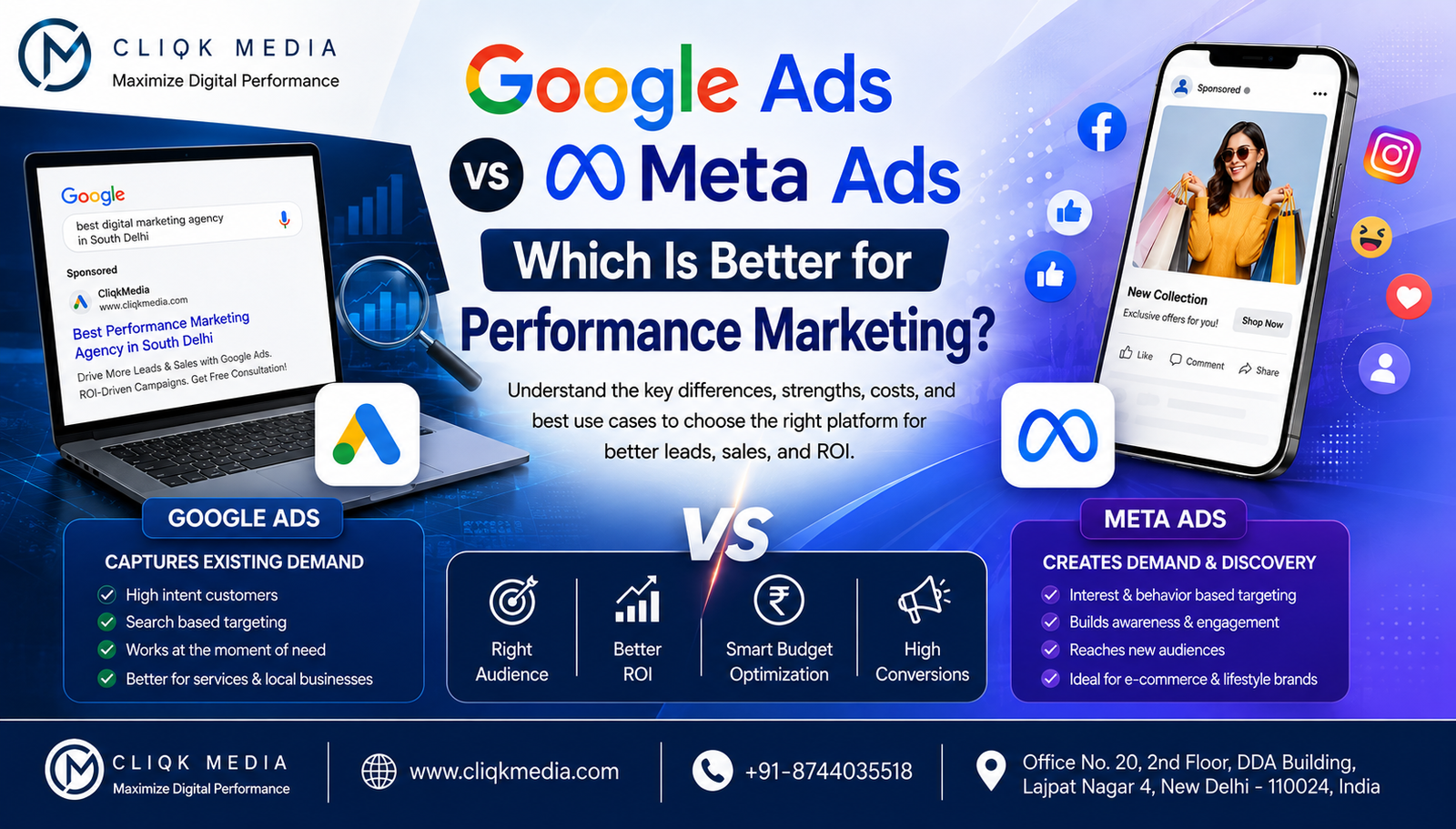
Google Ads vs Meta Ads: Which Is Better for Performance Marketing?
Performance marketing has become one of the most effective ways for businesses to generate leads, sales, and measurable growth. Among the many advertising platforms available today, Google Ads and Meta Ads are two of the most powerful choices. But which one is truly better for performance marketing?
The answer depends on your business goals, target audience, industry, budget, customer journey, and offer. Google Ads and Meta Ads work differently. Google often captures existing demand when people are actively searching, while Meta can help businesses create demand and reach people based on interests, behaviors, engagement, and other signals.
For businesses looking for the best performance marketing agency in South Delhi, understanding the differences between these platforms can help make advertising budgets far more effective.
Google Ads
Capturing high-intent commercial search queries at the moment of decision.
- ➔ Search & Shopping Ads
- ➔ Performance Max & AI Bidding
- ➔ High-Intent Lead Acquisition
- ➔ Local & B2B Conversions
Meta Ads
Creating brand demand & visual discovery across Instagram and Facebook.
- ➔ Reels, Stories & Feed Formats
- ➔ Advantage+ Creative & Placements
- ➔ Instant Forms & WhatsApp Leads
- ➔ Visual E-Commerce Scaling
What Is Google Ads?
Google Ads is Google's online advertising platform. One of its most important formats is Search advertising, where businesses can show ads when users search for products or services related to their business.
Google also offers other campaign types. Performance Max, for example, can distribute advertising across Google's channels, including Search, YouTube, Display, Discover, Gmail, and Maps, while using AI to optimize bidding, audiences, and creative toward performance goals.
Google Ads is particularly valuable when people already have a specific need and are actively looking for a solution. For example, someone searching for "best digital marketing agency in South Delhi" already has clear commercial intent. A well-optimized Google Ads campaign can place a business in front of that user at the exact moment they are searching.
What Are Meta Ads?
Meta Ads are advertisements across Meta's platforms, including Facebook and Instagram. Unlike traditional search advertising, Meta can reach people while they are discovering content rather than actively searching for a specific service.
Meta's advertising system uses campaign objectives to identify people who are more likely to take the desired action, such as purchasing a product, visiting a website, or submitting contact information. Meta also uses AI and automation through its Advantage+ tools, which can automate audience selection, placements, budget allocation, and creative optimization.
This makes Meta particularly useful for creating demand, building awareness, generating leads, and reaching audiences who may not yet be actively searching for a product or service.
Google Ads vs Meta Ads: The Main Difference
The biggest difference is user intent.
Google Ads generally works by capturing existing intent — a person searches for something, and the business tries to appear when that search happens. Meta Ads generally works by finding and influencing potential customers based on audience and behavioral signals while they are using Facebook, Instagram, and related Meta platforms.
The Intent Formula for Performance Marketers:
Both channels are incredibly valuable, but they operate at distinct stages of the customer conversion journey.
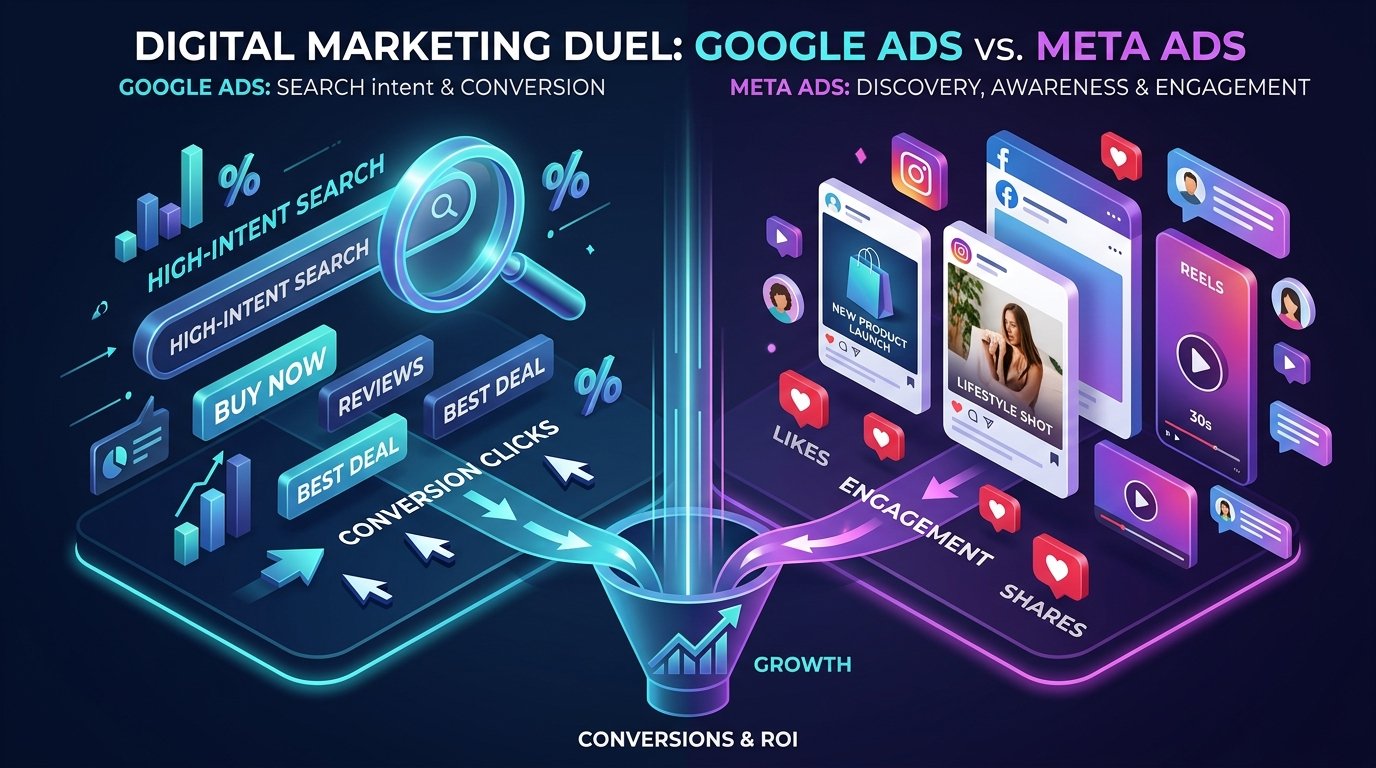
Google Ads Is Strong for High-Intent Customers
Google Search is often particularly effective for services and products where customers already know what they want. Examples include:
- Digital marketing & SEO services
- Lawyers, doctors, healthcare clinics, and specialized consultants
- Home repair, maintenance, and real estate services
- B2B enterprise software and SaaS solutions
- Local commercial services with immediate consumer demand
When someone searches with commercial intent, they are often closer to making a decision. Google's Smart Bidding uses machine learning to optimize bids toward conversions or conversion value at auction time, with strategies such as Target CPA, Target ROAS, Maximize Conversions, and Maximize Conversion Value — which makes accurate conversion tracking especially important.
Meta Ads Is Strong for Discovery and Demand Generation
Meta has a major advantage when the product or service benefits from visual presentation, storytelling, or audience discovery. Common examples include:
- Fashion, beauty, apparel, and lifestyle brands
- Restaurants, hospitality, and fitness brands
- Online education, courses, and coaching programs
- Consumer events, apps, and lifestyle services
People may not be searching for these products at that exact moment, but compelling creative can capture their attention and create instant desire. Meta's Advantage+ audience tools can expand beyond initial audience suggestions when the system predicts that broader targeting could improve performance — making Meta useful for both cold prospecting and high-conversion remarketing campaigns.
Which Platform Is Better for Lead Generation?
Both platforms can generate leads, but the best option depends on the type of lead and how customers make decisions. Google Ads can work exceptionally well when customers actively search for a service — a person searching for "performance marketing agency in Delhi" has already demonstrated relevant intent.
Meta Ads can generate leads by reaching potential customers through content, forms, messages, or other conversion experiences, supporting lead campaigns using native instant forms, WhatsApp direct messaging, and calling options. For a local service business, Google may capture high-intent prospects while Meta can build a massive qualified pipeline and support remarketing.
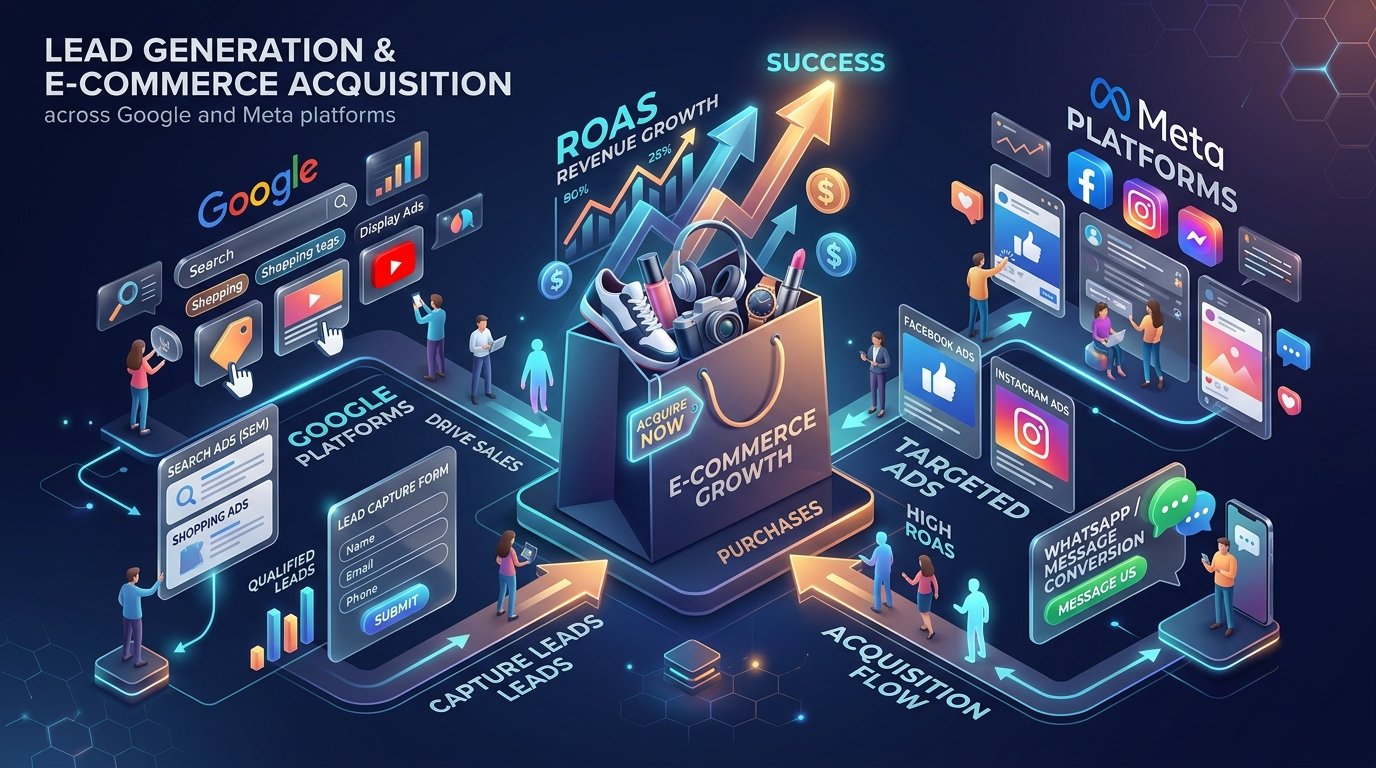
Which Platform Is Better for E-commerce?
For e-commerce, both platforms can be powerful. Google can capture demand from people searching for products and can use shopping-oriented campaign formats and Performance Max to reach customers across Google's entire ecosystem.
Meta is valuable for product discovery because strong images, videos, product demonstrations, testimonials, and offers can encourage people to explore a product they had not previously considered. For many e-commerce businesses, using both platforms creates a stronger customer acquisition system than depending on one channel alone.
Google Ads vs Meta Ads for Brand Awareness
Meta generally has a strong advantage for visual brand-building because businesses can place content into social feeds, Stories, Reels, and other placements. Meta's Advantage+ placements can automatically distribute ads across Facebook, Instagram, Messenger, and Audience Network based on opportunities for performance.
Google can also support awareness through YouTube, Display, Discover, and other surfaces, particularly through broader campaign types such as Performance Max. The best choice depends on whether awareness is the primary objective or whether awareness needs to connect directly to conversions.
Cost: Is Google Ads More Expensive Than Meta Ads?
There is no universal answer. Advertising costs depend on several dynamic factors:
- Industry, competition levels, and geographical location
- Audience saturation and commercial keyword demand
- Creative quality, ad relevance, and landing page experience
- Conversion rate and campaign objective configuration
- Customer lifetime value (LTV) and business margins
A campaign with a lower cost per click is not automatically better. The more important question is whether the traffic produces valuable customers. For example, paying ₹100 for a highly qualified lead may be far more profitable than paying ₹30 for an unqualified lead. Performance marketing should therefore be judged using business metrics rather than clicks alone — including Cost Per Lead (CPL), Cost Per Acquisition (CPA), Conversion Rate, Return on Ad Spend (ROAS), Customer Acquisition Cost (CAC), Revenue, and Qualified Lead Rate.
Google Ads vs Meta Ads: Comprehensive Comparison
| Performance Factor | Google Ads | Meta Ads |
|---|---|---|
| Primary strength | Capturing search intent | Creating demand & discovery |
| Audience behavior | Actively searching with intent | Browsing and discovering content |
| Best for | High-intent products & services | Visual products, discovery, awareness |
| Lead generation | Strong for search-driven demand | Strong for instant forms & social leads |
| E-commerce | Excellent for product search & shopping | Excellent for product discovery & impulse |
| Creative importance | Important (Copy & extensions) | Extremely critical (Video, UGC, Reels) |
| Targeting approach | Keywords, search themes & intent signals | Audiences, interests, lookalikes & AI |
| Retargeting | Strong (Search & Display Remarketing) | Exceptional (Custom & Lookalike Audiences) |
| AI automation | Smart Bidding, Performance Max | Advantage+ audience, placements & creative |
| Customer journey stage | Bottom-of-funnel (Closer to decision) | Top & Middle-of-funnel (Discovery to action) |
Should You Use Google Ads or Meta Ads?
The best choice should be tailored directly to your specific business model.
🔍 Choose Google Ads When:
- ✓ Customers actively search for your service or product
- ✓ You operate in a high-intent or urgent category
- ✓ You want to capture demand immediately
- ✓ Your business relies on local map & search queries
- ✓ You have dedicated landing pages with clear conversion tracking
When You Should Use Both:
You want to capture existing demand and create new demand at the same time. A customer may discover your company through Meta, visit your website, leave without converting, and later search for your brand or service on Google. This creates an opportunity for both platforms to contribute harmoniously to the complete customer journey.
Why Conversion Tracking Matters
One of the most important elements of performance marketing is accurate tracking. Businesses should know which campaigns generate:
- Phone calls and WhatsApp inquiries
- Form submissions, consultation bookings, and quotes
- E-commerce purchases and qualified high-ticket leads
- Bottom-line pipeline revenue and actual ROAS
Google emphasizes accurate conversion data for Smart Bidding, while Meta relies heavily on the Meta Pixel and Conversions API (CAPI) to support deep measurement and machine-learning optimization. Without reliable conversion data, businesses risk optimizing toward vanity actions that look good in a dashboard but fail to produce measurable revenue.

How CliqkMedia Can Help
Choosing between Google Ads and Meta Ads is only the first step. Building a profitable performance marketing campaign requires deep market research, audience modeling, creative development, pixel tracking, continuous A/B testing, and agile optimization.
As the best performance marketing agency in South Delhi, CliqkMedia delivers custom performance marketing solutions designed around your bottom-line business goals. Our full-stack services include Google Ads management, Meta Ads scaling, PPC advertising, lead generation funnels, retargeting, conversion rate optimization (CRO), advanced attribution analytics, and growth strategy.
We focus on mapping the customer journey and selecting the ideal channel mix for your unit economics rather than applying cookie-cutter formulas. Our mission is to help businesses refine their targeting, capture high-quality pipeline, increase conversions, and maximize the return on every advertising rupee spent.
Final Verdict: Google Ads or Meta Ads?
There is no single winner. Google Ads is often the better choice for capturing high-intent demand, especially when customers are actively searching for a product or service. Meta Ads can be the better choice for creating demand, visual storytelling, audience discovery, and social-based lead generation.
For many businesses, the strongest approach is not choosing one platform but using both strategically. Google can capture the people who are already looking. Meta can help introduce your brand to people who may become future customers. Together, they create a complete, high-converting performance marketing engine.
The key is not simply where you advertise. The real advantage comes from having a clear objective, accurate tracking, strong creative, relevant landing pages, the right audience, and continuous optimization. With the right strategy — and the right best performance marketing agency in South Delhi by your side — Google Ads and Meta Ads can both become powerful drivers of sustainable business growth.